About the project
This project (EMOMIS) was funded with 400.000 Euros by the Vienna Science and Technology Fund (WWTF) from November 2021 to June 2025. What we did in 5 bullet points:
- We investigated how emotional state influences discernment between true and false news, and which emotions such news trigger, and what their function in the processing of misinformation is.
- We investigated the large-scale interplay of emotions around news of different trustworthiness on Twitter from 2020 to 2023.
- We evaluated ways of measuring misinformation in social media data.
- We developed novel interventions that consider the social identities our believes and emotions around them are linked to.
- We simulated the dynamics of emotions around news shared by politicians, and the potential effect of algorithmic interventions on misinformation spreading using Agent Based Modelling.
Project Team
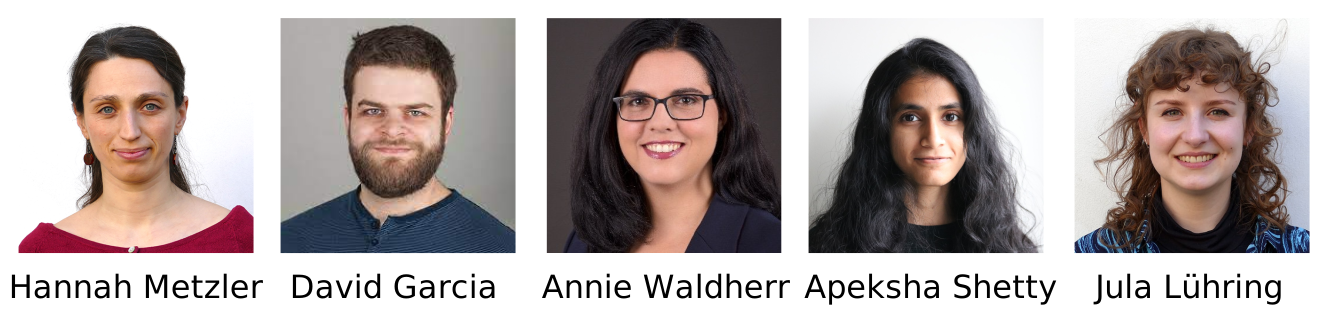
- Hannah Metzler (PI), Meduni Wien & Complexity Science Hub Vienna
- Apeksha Shetty (PhD student), Complexity Science Hub Vienna
- Jula Lühring (PhD student), University of Vienna
- David Garcia (Co-PI), University of Konstanz & Complexity Science Hub Vienna
- Annie Waldherr (Co-PI), University of Vienna
Follow us on social media
 ___
___
Publications
Blogposts
Podcasts & videos
- German:
- Erklär mir die Welt Podcast: #352 deep dive: Mythen über Social Media
- #81 Mind / Machine Podcast: News, Nuancen, mentale Gesundheit: Was Social Media wirklich mit uns macht.
- DerStandard Edition Zukunft Klimafragen Podcast: Wahrheit gegen Lüge: Die Psychologie hinter Fake News
- Vortrag: Polarisierung durch Algorithmen? Demokratie und Meinungsbildung im digitalen Zeitalter – Mythen auf dem Prüfstand
- English
- The Monkey Dance Episode 36 - What makes us engage with content?
- Talk about our project results on the Social Dynamics around Misinformation Spreading on Social Media
- Jula introducing her research
- Hannah about her research at the Complexity Science Hub
News articles (in English)
- Spotting climate misinformation with AI requires expertly trained models, Science News (14.04.2025)
- How NewsGuard became democracy’s digital fact-checker – and why critics got it wrong, MSN news.
News articles (in German)
- APA Science about our paper on the role of emotions for misinformation (31.03.2025). Covered by ORF Ö3, The International, Krone, MSN, NÖN, Puls24, Oberösterreichsche Nachrichten.at, Salzburger Nachrichten.
- Our paper analysing the NewsGuard database in international and national news media (14.03.2025):
- Neue Studien bestätigen, dass Fake News vor allem aus dem rechten Lager stammen, DerStandard.
- Medien in Österreich relativ vertrauenswürdig, Science ORF.at.
- Online-Medien in Österreich sind weit vertrauenswürdiger als jene in den USA. Die Presse.
- Medien in Österreich weit vertrauenswürdiger als in den USA bewertet, Science APA.
- Hannah gave an interview for the weekly newspaper “Das Parlament” (in German): Angst und Wut sind effektive Treiber. (17.01.2025)
- Apeksha is featured in a (German) article about the new digital humanism doctoral college. (03.12.2024)
- Mythos Fehlinformation: Warum soziale Medien weniger gefährlich sind, als wir denken, Spektrum der Wissenschaft online and in the print edition Spektrum - Die Woche 35/2024. On political misinformation, propaganda, elections, algorithms, and AI. (22.08.2024)
- Social media and debates about climate change (26.07.2023), covered by DerStandard, Science.ORF, FM4 news.
Preprints
- Lühring, J., Garcia, D., Waldherr, A., Lasser, J., Shetty, A., & Metzler, H. (2025).
Quantifying the Causal Effects of Misinformation on Engagement and Emotions on Social Media.
PsyArXiv. https://doi.org/10.31234/osf.io/cemw7_v1
- Bluesky thread about the study.
- Shetty, A., Simmendinger, E., Lühring, J., Garcia, D., Waldherr, A., & Metzler, H. (2026). Emotions, Group Cues, and Algorithmic Interventions: An Agent-Based Model of Elite Retweeting on Twitter. PsyArXiv. https://osf.io/preprints/psyarxiv/6meqv_v1/
Scientific journal articles
- Lühring, J., Metzler, H., Lazzaroni, R., Shetty, A., & Lasser, J. (2025). Best practices for source-based research on misinformation and news trustworthiness using NewsGuard. Journal of Quantitative Description: Digital Media, 5. https://doi.org/10.51685/jqd.2025.003
- Lühring, J.*, Shetty, A.*, Koschmieder, C., Garcia, D., Waldherr, A., & Metzler, H. (2024). Emotions in misinformation studies: Distinguishing affective state from emotional response and misinformation recognition from acceptance.
Cognitive Research: Principles and Implications, 9(1), 82. https://doi.org/10.1186/s41235-024-00607-0. Data, Code, Pre-registration & SI.
- Bluesky thread summary.
- Metzler, H., & Garcia, D. (2023). Social drivers and algorithmic mechanisms on digital media. Perspectives on Psychological Science 0(0). https://doi.org/10.1177/17456916231185057.
For the general public
- Mythos Fehlinformation: Warum soziale Medien weniger gefährlich sind, als wir denken
- Spektrum - Gehirn&Geist, (7.02.2025).
- Spektrum der Wissenschaft online, (22.08.2024).
- Spektrum - Die Woche 35/2024, (26.08.2024).
- Open Access Version as a Blogpost.
- Metzler, H. (2023). Emotions and group dynamics around misinformation on social media, Chapter 4, Synthesis Report on Climate misinformation in a climate of misinformation, Stockholm Resilience Centre.
Conference and seminar talks
- Lühring, J. (15.06.2025). Causal Effects of Misinformation on Online Interactions. Talk in the panel on Causal Inference and Network Analysis, 74th Conference of the International Communication Association, Denver, USA.
- Lühring, J. (15.06.2025). Tool Demo: Best Practices for Evaluating News Source Trustworthiness with NewsGuard. Talk in the panel on Computational Methods Tool Development and Demonstration, 74th Conference of the International Communication Association, Denver, USA.
- Luehring, J. (30.04.2025). Misinformation and Emotions Online. Invited talk at the Social Data Science Colloquium, University of Konstanz, Germany. https://julaluehring.github.io/2025-emomis-konstanz
- Lühring, J. (04.09.2024) Effects of Misinformation on Online Dicussions, Symposium MISDOOM 2024, Münster, Germany.
- Shetty, A. (04.09.2024) Emotional Dynamics and Algorithmic Interventions: Curbing Misinformation Among Political Elites on Twitter, Symposium MISDOOM 2024, Münster, Germany.
- Luehring, J. (05.07.2024). Emotional misinformation diffusion: Mapping socio-affective dynamics in the digital information ecosystem. Invited talk at the Emotional Speech Workshop, Ruhr-Universität Bochum, Germany.
- Lühring, J. (14.05.2024) Misinformation in den sozialen Medien, guest lecture in “Theories and Practices of Social Media Communication”, University of Vienna.
- Shetty, A. (16.05.2024) Emotional Dynamics and Algorithmic Interventions: Curbing Misinformation Among Political Elites on Twitter, University of Konstanz.
- Lühring, J. (04.05.2024) Effects of source trustworthiness on online discussions, 2024 COMPTEXT Meeting, 2024 COMPTEXT Meeting, Amsterdam, Netherlands.
Internships
- March-July 2024: Gabija Aurylaite from University of Vienna runs a large experiment with our social identity intervention.
- 2023: Esther Simmendinger, Master thesis with David Garcia at University of Konstanz
- 2023: Nele Hapig, Master thesis with David Garcia at University of Konstanz
- June-August 2023: Ruggero Lazzaroni from RWTH Aachen did a summer research internship at the CSH, funded by an Erasmus scholraship, to investigate the validity of the NewsGuard news reliability ratings
- Since September 2023: Adam Urosevic joined us for an internship with Jula Lühring on reconstructing the Austrian Twitter network around political news, in relation to the reliability of news shared.